Most private-label laundry sheet conversations start with cleaning performance. They almost never end there.
Sooner or later, a buyer washes a load with a sample, pulls the towels from the dryer, holds one to their face, and asks a very practical question: why does it smell clean in the package but quiet on the fabric?
That question matters most for the brands you might expect to be the most prepared: candle brands, room spray brands, body care companies, hotel amenity programs, boutique retailers, and premium home-care lines. Many of them already have a scent identity. Their customers recognize a bergamot opening, a soft floral heart, a green fig note, or a clean musk dry-down.
For these brands, a laundry product is not just another SKU. It is an extension of the brand memory. If the sheet cleans well but does not carry the scent onto dry fabric, the product can still feel unfinished.
That is why scent development in laundry detergent sheets needs to be treated as product engineering, not decoration.
The Physics Problem Behind Laundry Sheet Scent
A laundry detergent sheet has very little room to work with.
A typical sheet may weigh only a few grams. Inside that small format, the formula still needs to carry surfactants, builders, film-forming materials, enzymes or cleaning boosters when used, moisture control, and the ingredients that help the sheet stay flexible, stable, and dissolvable. Fragrance gets only part of that limited space.
Then the sheet goes into the main wash. The wash liquor contains surfactants, and surfactants are designed to remove oils from fabric. Perfume oil is still oil. A fragrance that is not protected or designed for fabric deposition can be diluted, solubilized, rinsed away, or lost during drying.
There is also a challenge specific to the sheet format. Laundry detergent sheets are made through wet processing and drying. Heat and airflow can flatten the more volatile top notes that make a scent feel bright, fresh, fruity, green, or expensive.
Put those together and you get the common market problem: a detergent sheet smells strong in the box, blooms briefly in the wash, and leaves very little on folded laundry.
The Six Moments Where a Customer Smells Your Product
A fragrance brief becomes much clearer when we stop treating scent as one moment.
For laundry detergent sheets, the scent journey usually has six stages:
- Package scent: what the customer smells when opening the box or pouch.
- Wash bloom: the scent released when the sheet dissolves in water.
- Wet fabric scent: what remains when clothing comes out of the washer.
- Dry fabric scent: the scent after line drying or machine drying.
- Wardrobe scent: what remains after folded laundry sits in a drawer or closet.
- Wear scent: the subtle release that can happen when fabric is handled or worn.
A formula can perform well at one stage and poorly at another. Out-of-pack scent is usually the easiest to create, because free fragrance on or near the sheet surface can do much of the work. Dry fabric, wardrobe, and wear are harder. Those are the moments customers remember in reviews.
What Microencapsulation Actually Does
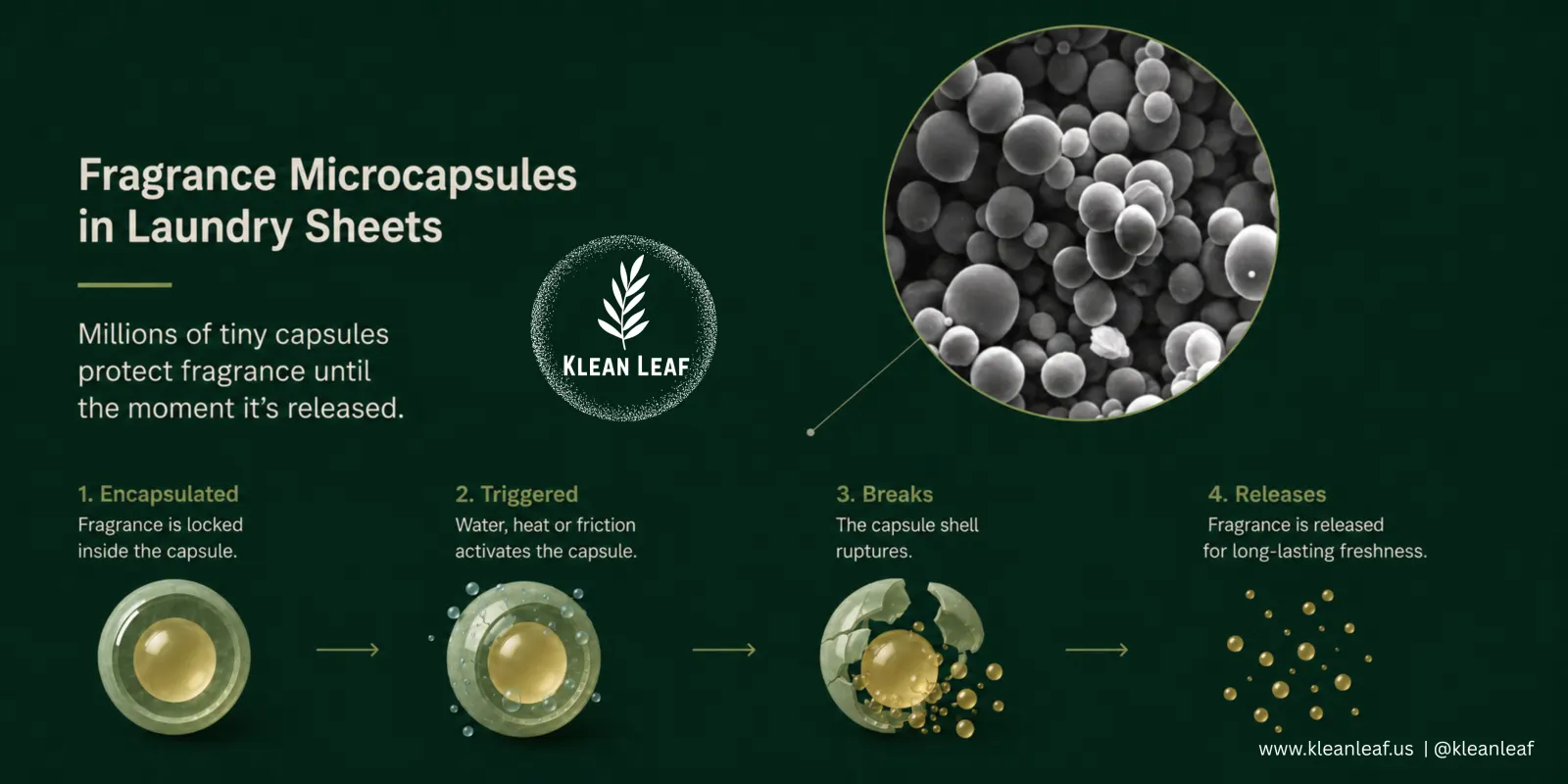
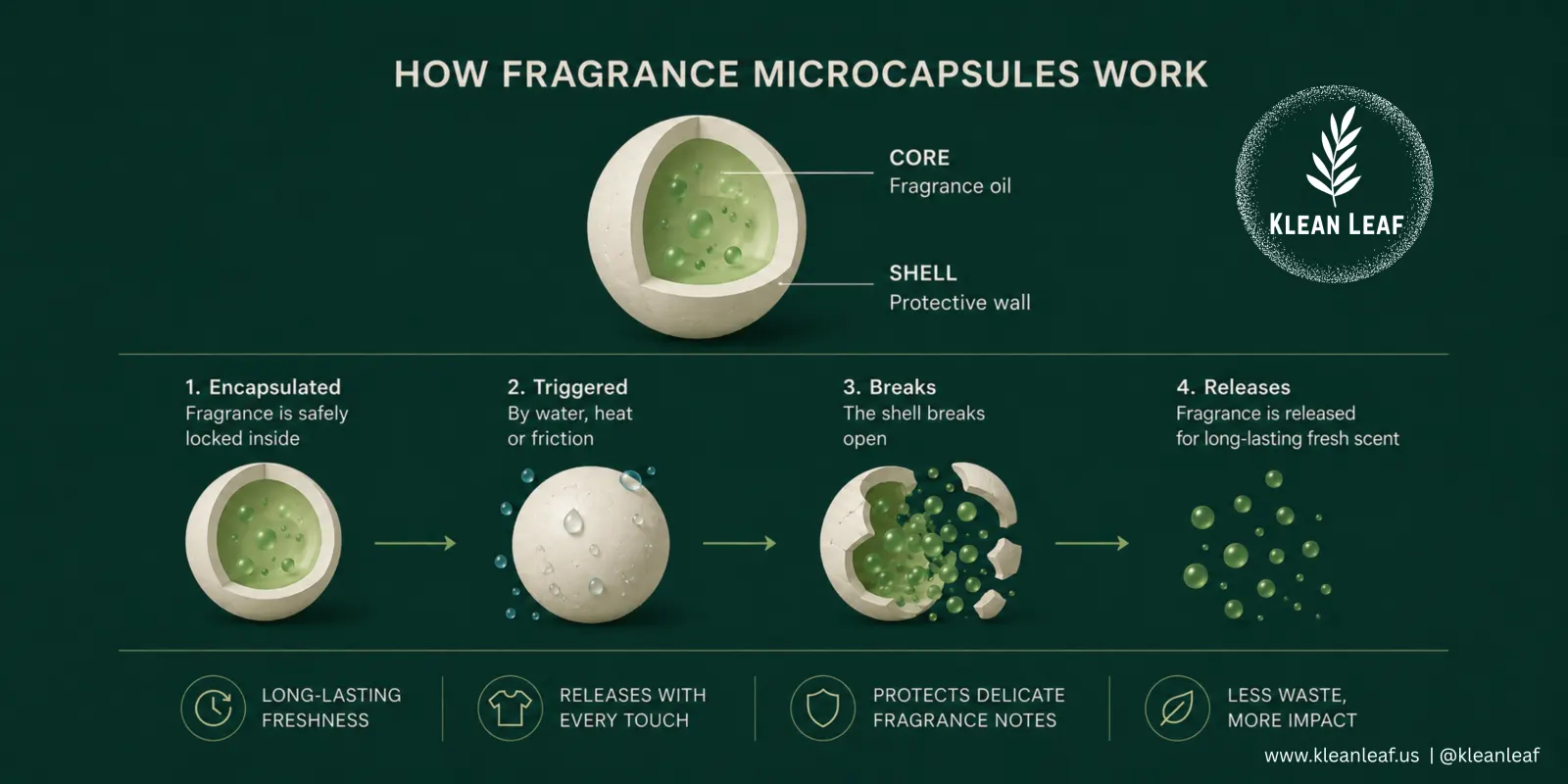
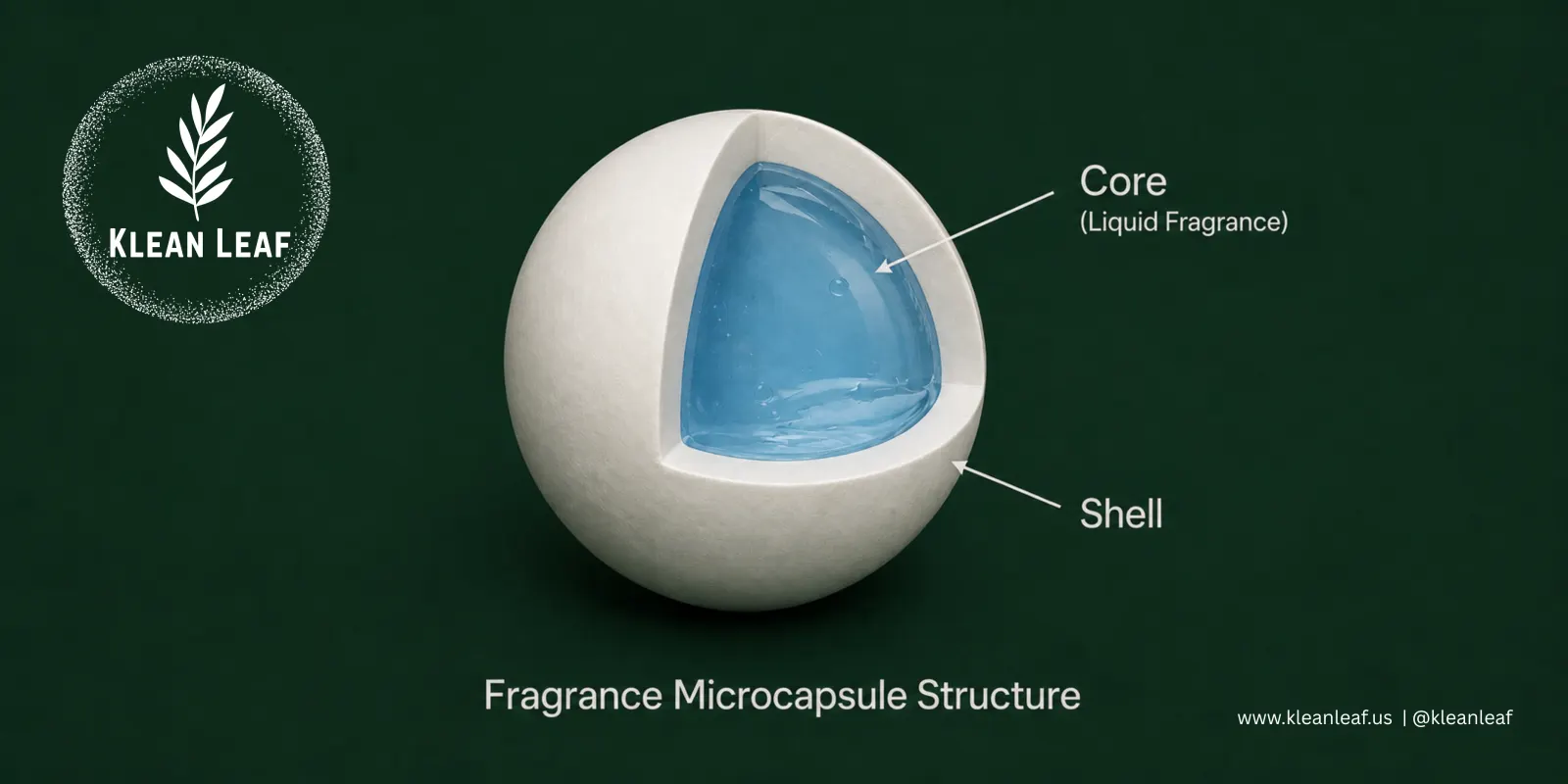
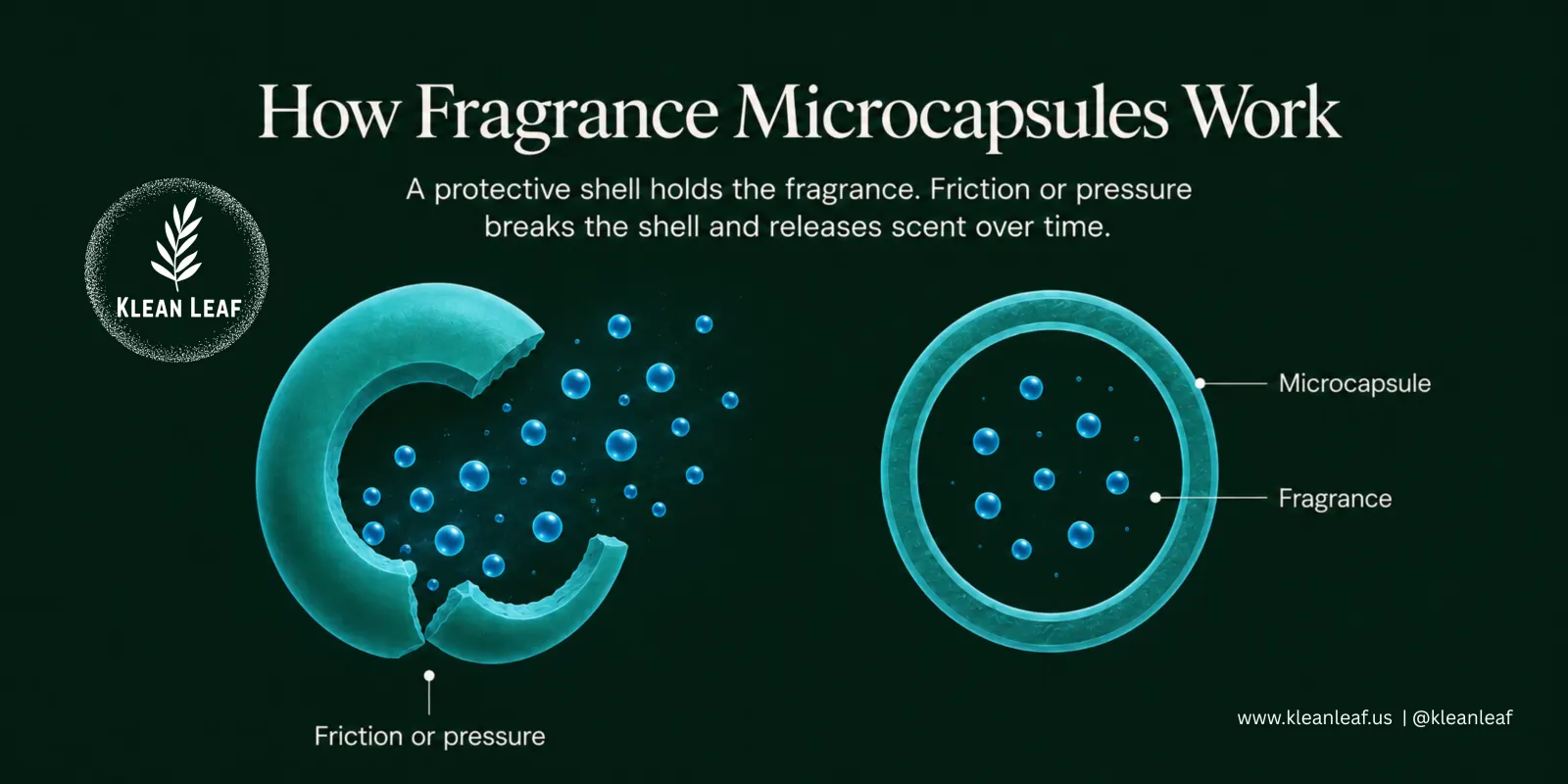
Microencapsulation places tiny droplets of fragrance oil inside a protective shell instead of leaving all the perfume oil exposed in the formula.
The goal is not simply to make the sheet smell stronger. The goal is to protect part of the fragrance, help it survive the laundry process, deposit it onto fabric, and release it later at the right moment.
Givaudan describes encapsulation as a way to protect delicate fragrance oils in product bases such as detergents and carry the scent through several stages of use, including the wash cycle, fabric deposition, drying, and later friction during wear.
That last point is important. Free fragrance gives an immediate scent impression, but it tends to fade from the moment the package is opened or the wash begins. Encapsulated fragrance is a delayed-release system. It can help store part of the scent on fabric for later handling, folding, or wearing.
Why This Matters for Brands With a Real Fragrance Identity
For many years, laundry fragrance leaned toward musks, woods, lavender, powder, and clean-linen accords because many materials in those families naturally last better on fabric.
Modern brands often want something more specific.
They may want bergamot and neroli, pear and peony, green fig and cedar, white tea and soft musk, orange blossom and clean cotton, or a laundry version of a scent their customers already know from candles, hand soap, body wash, linen spray, or home fragrance.
Those more delicate directions are harder to deliver in laundry because many citrus, fruity, green, and light floral notes are more volatile and less naturally substantive on fabric.
Givaudan has said that encapsulation technologies expanded the palette for laundry perfumery by allowing perfumers to work with lighter citrusy, fruity, and floral notes that were traditionally harder to keep noticeable on dry textiles.
For a private-label brand, that can be the difference between a generic scented sheet and a product that still feels like the brand after the wash.
What Cannot Be Microencapsulated Well
Microencapsulation is useful, but it is not magic. Not every existing fragrance oil can be placed inside a capsule unchanged and expected to perform beautifully in a laundry sheet.
Very Volatile or Water-Soluble Materials Can Leak
A capsule shell is a barrier, not a vault. Some small, mobile, highly volatile, or more water-soluble materials can diffuse through the shell over time, especially in product bases that contain surfactants or solvents.
Givaudan patent literature discusses this challenge in technical terms: core-shell microcapsules can be permeable, and perfume ingredients may leak from the core over time, particularly in aqueous media containing surfactants. That is one reason perfume ingredient selection, polarity, volatility, and ClogP are important in encapsulated fragrance design.
Some Natural or Essential Oil Directions Need Extra Care
Natural positioning can be beautiful, but high essential-oil loads are not automatically easier. Many essential oils contain terpene-rich materials that may create stability or compatibility challenges depending on the capsule shell and the detergent base.
For brands, the practical question is not only whether a scent is natural or synthetic. It is whether the chosen fragrance system remains stable in the sheet, survives storage, and performs on fabric.
Some Notes Should Stay Outside the Capsule
If every part of the fragrance is delayed-release, the customer may open the package and smell very little. Most serious laundry fragrance systems use a balance: free fragrance for the early moments, encapsulated fragrance for the long tail.
The ratio is a design decision. A subscription brand, hotel program, refill shop, and premium home fragrance brand may not want the same balance.
Some Brand Requirements May Rule It Out
Fragrance-free positioning, clean-ingredient screens, retailer restrictions, certification goals, allergen management, or regional compliance requirements may limit whether encapsulated fragrance is appropriate for a specific product.
That is a brand strategy conversation as much as a chemistry conversation.
Laundry Sheet Manufacturing Adds Another Constraint
There is a reason microencapsulation for laundry sheets needs to be discussed with the manufacturing process in mind.
Friable perfume microcapsules are designed to break later under friction. That is exactly what makes them useful on fabric. It also means they can be damaged too early if the process exposes them to too much shear, pressure, heat, or mechanical stress.
Procter & Gamble's Laundry detergent sheet with microcapsules patent describes non-fibrous laundry detergent sheets using friable perfume microcapsules. The patent notes that traditional manufacturing approaches can lead to premature rupture of those capsules and describes adding microcapsules after sheet formation as one way to improve the yield of intact capsules in the finished sheet.
The takeaway for brands is simple: buying a microencapsulated fragrance and adding it to an existing sheet slurry does not automatically create long-lasting scent. The detergent chemistry, capsule chemistry, drying conditions, and point of addition all matter.
Why Adding More Fragrance Is Not Always Better
It is tempting to solve weak dry-fabric scent by increasing the fragrance level. Sometimes a small adjustment helps. But more fragrance does not automatically mean better fragrance performance.
Overloading fragrance can create new problems:
- The package may smell too strong in storage or transit.
- The sheet texture may change.
- The formula may become less stable.
- The scent may feel sharp, heavy, or less refined.
- The cost may rise without a meaningful improvement on dry fabric.
- Labeling, allergen, or market requirements may become more complicated.
For premium clients, fragrance quality matters as much as intensity. The goal is not to make the sheet loud. The goal is to make the right parts of the scent last in the right way.
The Regulatory Clock Brands Should Know About
Microcapsule chemistry is changing quickly, especially for brands that sell or plan to sell into Europe.
Under Commission Regulation (EU) 2023/2055, the EU restriction on intentionally added synthetic polymer microparticles applies from 17 October 2028 for detergents, waxes, polishes, and air care products unless another specific category applies. For synthetic polymer microparticles used in fragrance encapsulation, the listed date is 17 October 2029.
For brands with a multi-year product plan, this should be part of the fragrance brief. If long-lasting scent is central to your positioning, capsule chemistry, biodegradability direction, and market scope should be reviewed before launch, not after the product is already on shelf.
How to Brief a Scent So It Can Be Built
The best fragrance projects usually start with a clear brief, not a name like "fresh" or "floral."
If you already have a proprietary scent, a fragrance-house code, or a physical reference, our guide to custom fragrance sourcing, samples, and MOQ explains how those three project paths work.
Helpful information includes:
- A physical reference: send the candle, body wash, room spray, fragrance oil, or finished product if you have one.
- The stage that matters most: package scent, wash bloom, dry fabric, wardrobe, and wear do not require the same fragrance balance.
- Your intensity target: "clean and close to fabric" and "clearly noticeable after drying" are different products.
- Your hard constraints: target cost, certification needs, retailer requirements, allergen strategy, ingredient preferences, and market restrictions.
- Your sales region: fragrance preference and regulatory expectations vary across markets.
- Your format plan: sheet count, package type, fragrance-free versions, and SKU family all affect development.
The more specific the brief, the easier it is to avoid unnecessary sample rounds.
How to Evaluate a Scented Laundry Sheet Sample
Most scent decisions should be made from the finished sheet and the washed fabric, not from a bottle or fragrance strip.
If you are evaluating long-lasting fragrance, test it in a controlled way:
- Wash a standard cotton towel load instead of a random mixed load.
- Use the water temperature and dosage your customer is likely to use.
- Smell the product at each stage: package, wash bloom, wet fabric, dry fabric, wardrobe, and wear.
- Write the stages down separately instead of judging the scent as one overall impression.
- Fold the towels, place them in a drawer, and check again after several days.
- Rub the fabric before smelling if the system is designed for friction-triggered release.
- Repeat the test with a sample that has been stored in warm conditions to understand whether the scent changes after aging.
If a sample smells excellent on day one but is never tested after drying, storage, and handling, the evaluation is incomplete.
Technical References
- Givaudan - Fragrance performance in consumer products, including discussion of laundry encapsulation, dry-fabric performance, and lighter citrus, fruity, and floral notes.
- Givaudan - Long-lasting freshness technologies, including Mechacaps, PlanetCaps, Scentaurus, and Scenticaps.
- Givaudan SA - Encapsulated perfume compositions, US10806683B2, discussing core-shell microcapsules, leakage, surfactant media, and perfume ingredient selection.
- Procter & Gamble - Laundry detergent sheet with microcapsules, US11680232B2, discussing non-fibrous laundry detergent sheets, friable perfume microcapsules, top-note scent characters, and manufacturing point of addition.
- ACS Sustainable Chemistry & Engineering - Sustainable chemistry considerations for encapsulation of volatile compounds in laundry-type applications, a review of performance and sustainability challenges for fragrance encapsulates.
- Commission Regulation (EU) 2023/2055, covering intentionally added synthetic polymer microparticles and relevant transition dates.
Scent Is Part of the Product
Scent is the part of a laundry product customers judge quickly, but it is also one of the easiest parts to under-specify.
If your brand already has a fragrance identity, the goal is not to pour that scent into a sheet and hope it survives. The goal is to translate the identity into a laundry format: package, wash, wet fabric, dry fabric, wardrobe, and wear.
Klean Leaf helps private-label clients review fragrance options, finished-sheet samples, microencapsulated fragrance directions, fragrance-free alternatives, packaging needs, and production planning for laundry detergent sheet programs.
Email:
hello@kleanleaf.us
Frequently Asked Questions
Can laundry detergent sheets hold scent as long as fabric softener?
Not in exactly the same way. Fabric softener is usually dosed in a larger amount and often enters the rinse cycle, while a detergent sheet is smaller and works in the wash. A well-designed hybrid fragrance system can still create meaningful dry-fabric scent.
Do encapsulated fragrances work in cold water?
They can. Many fabric-care capsule systems are designed around fabric deposition and later friction, not simply heat. Cold-water performance still depends on the detergent formula, capsule type, fabric, wash conditions, and dosage.
Can Klean Leaf support fragrance-free and scented sheets in the same program?
Yes. Many private-label programs include both fragrance-free and scented versions. They should be treated as separate SKUs with separate artwork, production planning, and sample approval.
How many sampling rounds should a custom scent require?
Plan for more than one. The first round usually establishes direction. Later rounds may adjust intensity, package scent, dry-fabric performance, free-fragrance balance, encapsulated fragrance use, or stability after storage.
Is encapsulated fragrance compatible with PVA-free sheets?
It may be possible, but it should be reviewed as a formulation project. Film chemistry, capsule chemistry, processing conditions, fragrance load, dissolving behavior, and finished-sheet stability all need to work together.
Planning to launch your own laundry sheets brand?
Klean Leaf helps brands develop private-label laundry detergent sheets with formula, fragrance, packaging, sampling, and production support.