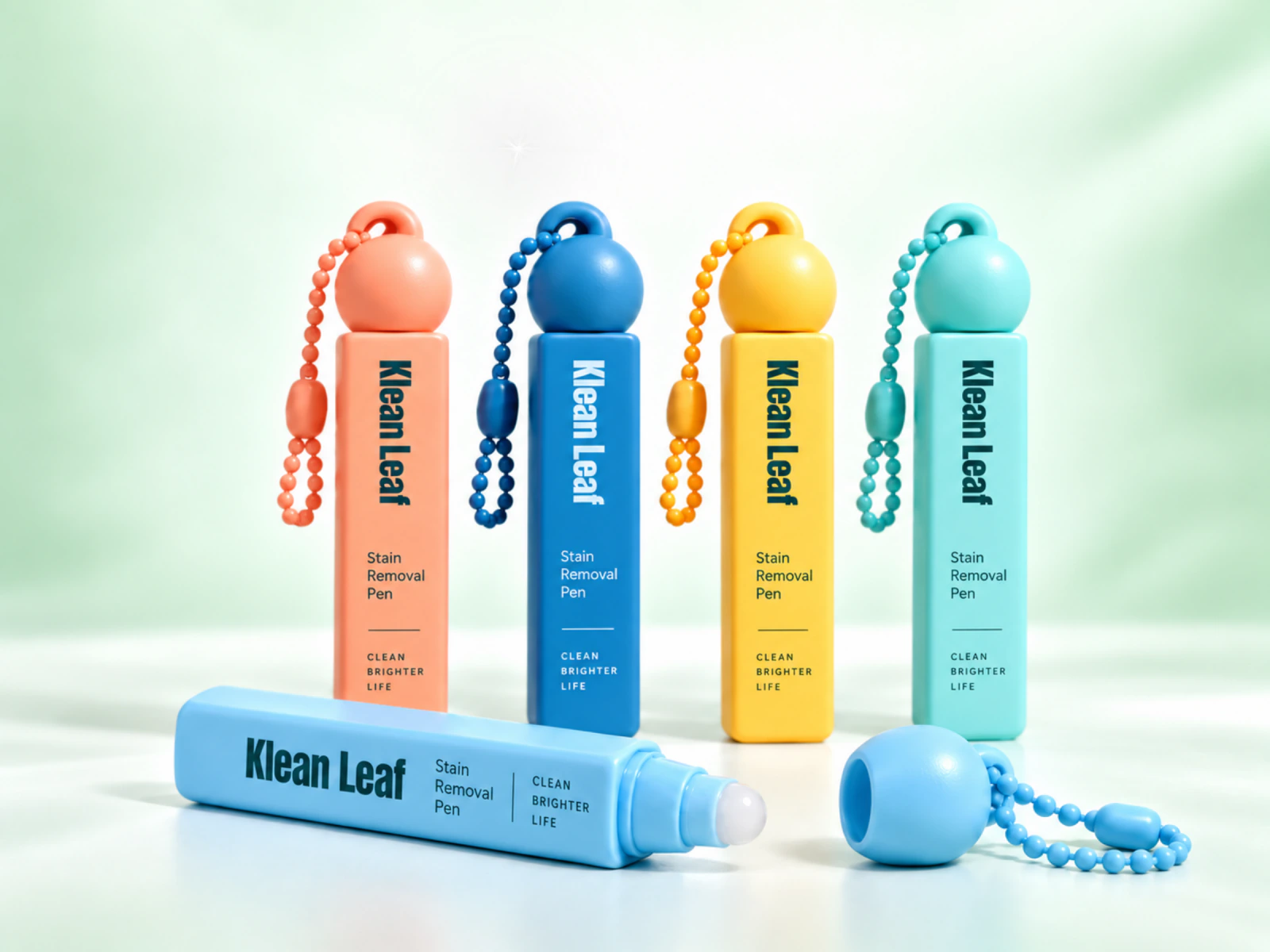
A private label stain remover pen can start with a 1,000-piece order using Klean Leaf's existing pen and formula. Sampling costs US$299, with sample development taking about three weeks. For brands that want more customization, we can develop a formula around target stains or create a new pen shape.
This guide explains how to develop custom stain remover pens with Klean Leaf, from choosing the formula and applicator to approving samples and planning delivery. The right starting point depends on what you want to change and how much you want to order.
Why Add a Stain Remover Pen to Your Product Line?
A stain remover pen puts a spot-cleaning formula into a compact applicator that customers can keep in a handbag, desk drawer, or travel kit. It gives them a convenient way to treat small spills while away from home, following the product's directions.
For a brand, that makes the format a practical addition to a laundry range, travel collection, gift set, or subscription box. It can sit alongside private label laundry detergent sheets as a portable stain-treatment option. The pen body also provides space for your branding on a product customers can carry and use repeatedly.
What Can You Customize?
Three parts shape the finished product: the cleaning formula, the applicator tip, and the pen body and packaging. You can start with an existing format or build a more distinctive product around your brief.
The Stain Remover Formula
Our existing formula is available for a logo-only private label project. If your customers have a particular need, we can develop adjustments around the stains that matter to them, such as coffee, tea, red wine, oily marks, or makeup.
These are development targets, and performance is evaluated during sampling. The stain, fabric, application method, and time before treatment all belong in the sample brief. Approve the finished pen on your intended stains and fabrics before moving into production.
Brush, Felt, or Roller Ball Applicator
Klean Leaf offers three applicator styles:
- Brush tip: soft bristles work the formula over the treatment area.
- Felt pen tip: a familiar marker-style applicator for targeting small spots.
- Roller ball: a ball tip that applies formula as it rolls across the stain.
Evaluate the tip with the proposed formula. During sample testing, check how easily the pen dispenses, how much liquid reaches the fabric, and how the applicator feels in use.
Pen Body, Logo, and Packaging
Our standard pen uses a plastic body. A logo-only project adds your branding to an existing pen without requiring a new mold. Discuss the logo placement, artwork, and retail packaging early so the sample and quotation reflect the product you intend to sell.
If the shape itself is part of your brand concept, we can discuss a custom pen body with its own mold. That route has a separate tooling cost and a minimum order confirmed for the design.
Match Enzymes to the Stains Your Customers Need to Remove
Different enzymes act on different components of a stain. Protein, cooking oil, starch, and fruit residues call for different approaches, and a single food spill may contain several of them. Identifying the main stain types helps us choose a more focused formula for your custom stain remover pen.
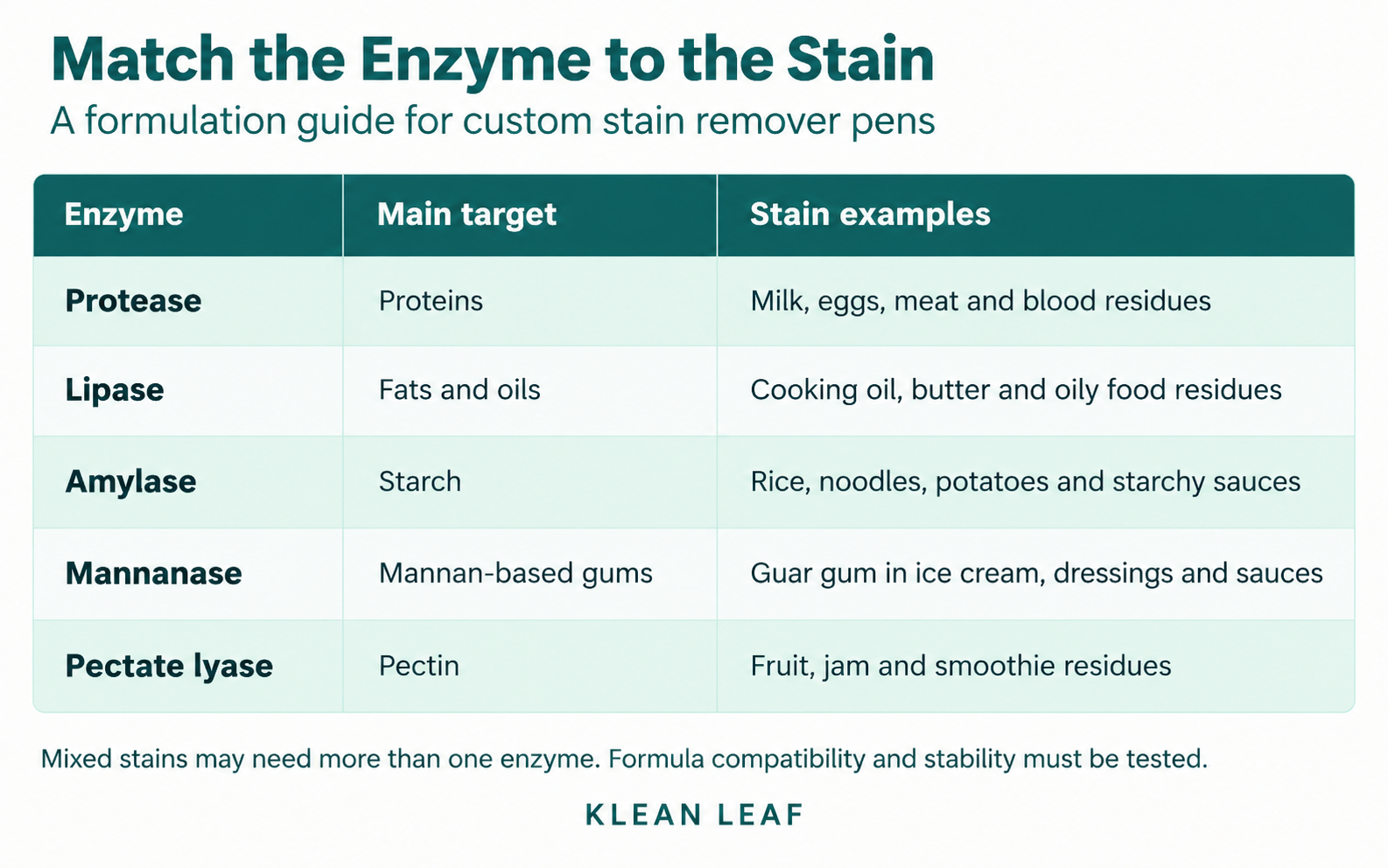
| Enzyme | Main target | Typical stain examples |
|---|---|---|
| Protease | Proteins | Protein residues in milk, eggs, meat, and blood |
| Lipase | Fats and oils | Cooking oil, butter, and susceptible oily components in body soils or cosmetics |
| Amylase | Starch | Starch residues from rice, noodles, potatoes, baby foods, and thickened sauces |
| Mannanase | Mannan-based thickeners, such as guar gum | Guar-gum-containing ice cream, salad dressings, and sauces |
| Pectate lyase | Pectin-related residues | Pectin-containing fruit, jam, smoothies, and fruit or vegetable drinks |
These are ingredient-selection guides, not a claim that one enzyme removes every part of a stain. Enzymes work alongside the rest of the cleaning formula.
Targeted Formulas or Multi-Purpose Stain Remover Pens?
If you can identify the main food or oil stains your customers face, we can select specific enzymes and supporting ingredients around that need. Tell us whether the priority is cooking grease, dairy spills, starchy sauces, or another recurring problem. A focused brief lets us optimize the formula for those stains and compare results during sampling.
We can also select raw-material options around your environmental goals, reviewing supplier information and suitability alongside cleaning performance. Share any ingredient preferences or environmental requirements at the start so they become part of the development brief.
Klean Leaf also offers multi-purpose development options for a wider range of everyday stains. A broader formula may be less optimized for one difficult stain than a dedicated formula, while offering more coverage across different spills. The actual balance depends on the enzyme blend and overall formulation, so compare finished samples on your priority stains.
For Protein-Based Food Stains and Cooking Oil: Protease + Lipase
If the two main targets are protein-based food residues and cooking oils, we can evaluate a combination of protease and lipase. Protease addresses the protein component, while lipase targets suitable fats and oils. This can be a useful starting point for a pen intended for meal-related spills.
Food stains can also contain starch, gums, pigments, or other components, so these two enzymes do not cover every food stain. For example, a starch-heavy sauce may call for amylase. Your sample brief helps R&D decide which components need attention.
Why R&D Does Not Simply Add Every Enzyme
Our R&D team emphasizes that adding more enzyme types does not automatically improve cleaning. Incompatible combinations can lose activity during storage. Proteases can break down other enzyme proteins in a liquid formulation, so the enzyme selection, pH, supporting ingredients, stabilization, and storage conditions all matter.
Multiple enzymes can work together when the combination is compatible and properly stabilized. We therefore evaluate the proposed blend in the finished pen for cleaning performance and stability before approving it. The goal is a formula that remains effective through its intended storage and use, with each enzyme serving a clear purpose.
Minimum Order Quantities for Private Label Stain Remover Pens
The minimum order quantity (MOQ) depends on the level of customization. The quantities below are measured in individual pens.
| Option | What you customize | Minimum order | New mold fee |
|---|---|---|---|
| Logo-only private label | Your branding on our existing pen and formula | 1,000 pens | None; uses an existing mold |
| Custom formula | A formula developed around your target stains, using our existing pen | 2,500 pens | None; uses an existing mold |
| Custom pen shape | A new pen body made with a dedicated mold | Quoted after the design is agreed | One-time fee quoted per design |
For a smaller first launch, the 1,000-pen logo-only option offers a lower starting quantity and avoids new tooling. A custom formula makes sense when specific stain-removal needs are central to the product. Choose a custom shape when the design is a priority and your budget allows for mold development.
The figures in this guide are planning references. Your project quotation confirms the selected configuration, fees, order quantity, and schedule.
Custom Pen Shapes and Mold Costs
A custom shape starts with the design and construction. We review the dimensions, finish, applicator, and whether the pen should be refillable before confirming the mold fee and MOQ.
In one UK client project, Klean Leaf developed a lipstick-style stain remover pen with a metallic-finish outer case and a plastic refill cartridge inside. The concept allowed customers to keep the outer case and replace the cartridge. The one-time mold fee for that project was approximately US$7,000.
That figure is an example, not a standard price for every custom shape. Bring sketches, reference photos, approximate dimensions, and your preferred finish to the first discussion. If you want a refillable design, include how you expect the refill to be replaced and packaged.
How Stain Remover Pen Sampling Works
Sampling lets you evaluate a working pen before placing a production order. The sampling fee is US$299, and sample development takes about three weeks once the brief is agreed and the fee is received.
- Share your brief. Describe the target stains, intended fabrics, ingredient or environmental requirements, sales market, expected order quantity, and launch timing. Identify the food or oil stains that matter most.
- Choose the pen and tip. Confirm whether you need logo-only branding, a custom formula, or a custom shape, together with a brush, felt, or roller ball applicator.
- Confirm the sampling scope and fee. Review what will be supplied, the artwork needed, sample shipping, and how revisions will be handled before paying the US$299 fee.
- We prepare the samples. Our team develops the agreed samples for your evaluation. Custom tooling requires a separate schedule.
- Test, give feedback, and approve. Evaluate the samples, discuss any changes, then approve the final specification and artwork before production.
A useful brief is specific. For example, “coffee spills on everyday cotton shirts, a felt tip, and a compact pen for travel kits” gives the development team a clearer starting point than “a pen that removes all stains.” Include your logo files and any packaging references alongside the product requirements.
What to Check Before Approving Your Samples
Use representative stains and fabrics, following the proposed instructions. Record the amount applied and the time between staining and treatment so you can compare versions consistently. Your review should cover:
- Cleaning results: how the target stain looks after treatment and after the fabric dries.
- Fabric appearance: any color change, visible ring, residue, or change in texture.
- Application: liquid flow, tip control, and ease of treating a small spot.
- Pen and packaging: cap fit, leakage during representative handling, print clarity, and readable directions.
Share photos and notes for each sample version. If delicate fabrics are part of the brief, establish suitability through testing rather than assuming the same instructions work for every material. Final product directions should reflect the approved formula and intended use.
Production and Shipping: How Long Does a Launch Take?
For an approved project using an existing pen body, allow approximately 50 to 60 days from order to delivery: roughly one month for production and one month for shipping. Production alone is approximately one month.
| Stage | Estimated time |
|---|---|
| Sample development | About 3 weeks after the brief and sampling fee are confirmed |
| Buyer testing and approval | Depends on your evaluation and any revisions |
| Production | About 1 month after sample approval and order confirmation |
| Shipping | About 1 month; depends on destination and shipping arrangements |
Three weeks of sample development plus the 50-to-60-day order-to-delivery estimate comes to roughly 10 to 12 weeks. Add time for sample transit, your testing and approval, and any revisions. A custom shape also needs mold development time, confirmed with the design quotation.
If you have a seasonal launch or retailer deadline, share it at the start. That gives us a date to work back from when planning samples, artwork, production, and shipping.
Confidentiality for Custom Designs and Formulas
Klean Leaf can sign a non-disclosure agreement (NDA) before you share sensitive designs, formula requirements, or unannounced launch plans. Let us know at the beginning so confidentiality arrangements are in place before the detailed brief is exchanged.
Start Your Custom Stain Remover Pen Project
Tell us which route you want to explore: logo-only private label, a custom formula, or a custom shape. Include your preferred tip, the stains and fabrics your customers need to treat, your expected order quantity, and your target market.
Contact Klean Leaf to discuss stain remover pen samples or email hello@kleanleaf.us. Our team can review your brief, confirm the sampling scope, and explain the next steps.
Frequently Asked Questions
What is the MOQ for private label stain remover pens?
Logo-only private label orders start at 1,000 pens using Klean Leaf’s existing pen and formula. Custom formula projects start at 2,500 pens. A custom pen shape has a separate MOQ confirmed after the design is agreed.
How much does stain remover pen sampling cost?
The sampling fee is US$299. Sample development takes about three weeks after the brief is agreed and the fee is received. Confirm sample quantity, shipping, and revision scope in the quotation; custom tooling needs a separate schedule.
Can Klean Leaf develop a formula for specific stains?
Yes. Share your main stains, intended fabrics, and ingredient or environmental requirements. Klean Leaf can select enzymes and supporting raw-material options around that brief, then evaluate cleaning performance, fabric suitability, and stability in the finished pen.
Which enzymes can target food stains and cooking oil?
For protein-based food residues and cooking oils, Klean Leaf can evaluate protease together with lipase. Protease targets proteins and lipase targets suitable fats and oils. Starch, gums, and other food components may need a different approach, so identify the specific spills in your sample brief.
Is a targeted stain remover pen better than a multi-purpose formula?
A targeted formula can be optimized for a defined stain type. A multi-purpose formula offers broader coverage and may be less optimized for one difficult stain. Neither approach is automatically better; compare finished samples against the stains your customers encounter most.
Why not add every enzyme to a stain remover pen?
More enzyme types do not automatically mean better performance. Some combinations can lose activity during storage, and proteases may break down companion enzymes. Compatible, stabilized blends can work together; Klean Leaf’s R&D team evaluates the proposed combination in the finished formula.
Which stain remover pen applicator tips are available?
Klean Leaf offers brush tips, felt pen tips, and roller ball applicators. Test the selected tip with the proposed formula to assess flow, control, and application on your intended fabrics.
Can I order a custom-shaped or refillable stain remover pen?
Yes. Klean Leaf can discuss a custom shape or refillable design and quote the mold fee and MOQ after reviewing the construction. One UK lipstick-style pen project had a mold fee of approximately US$7,000; this is a project example, not a fixed price.
How long do production and delivery take?
For an approved project using an existing pen body, production takes about one month. The combined production and shipping estimate is approximately 50 to 60 days from order to delivery. Sampling, buyer approval, revisions, and custom tooling add time.
Will Klean Leaf sign an NDA before development?
Yes. Klean Leaf can sign an NDA before you share sensitive formula requirements, custom designs, or launch plans. Raise the request before sending confidential project details.
Develop a Stain Remover Pen for Your Brand
Review the pen format, then discuss your target stains, applicator, branding, and sample requirements with Klean Leaf.
Sources & References
- BASF: Lavergy Enzymes
Technical background on protease, lipase, amylase, and mannanase in cleaning formulations.
- Novonesis: Pectate Lyases for Fruit Stains
How pectate lyase targets pectin-containing residues in fruit, jams, and drinks.
- Novonesis: Protease Performance and Stability
A March 2025 overview of protease stability and compatibility with companion enzymes.
- Catalysts: Stabilization of a Lipolytic Enzyme for Commercial Application
A 2017 research paper examining lipase stability for detergent applications.