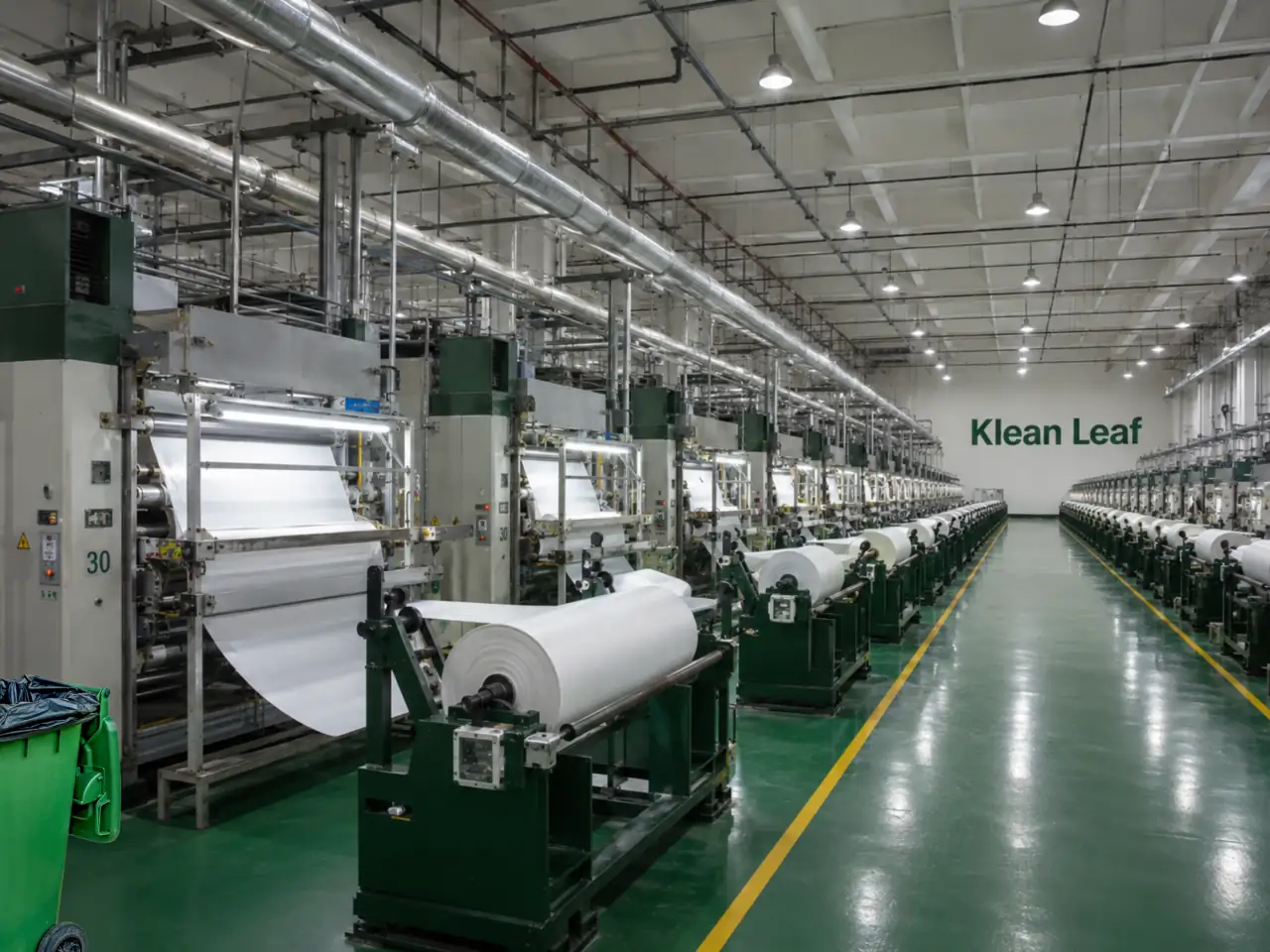
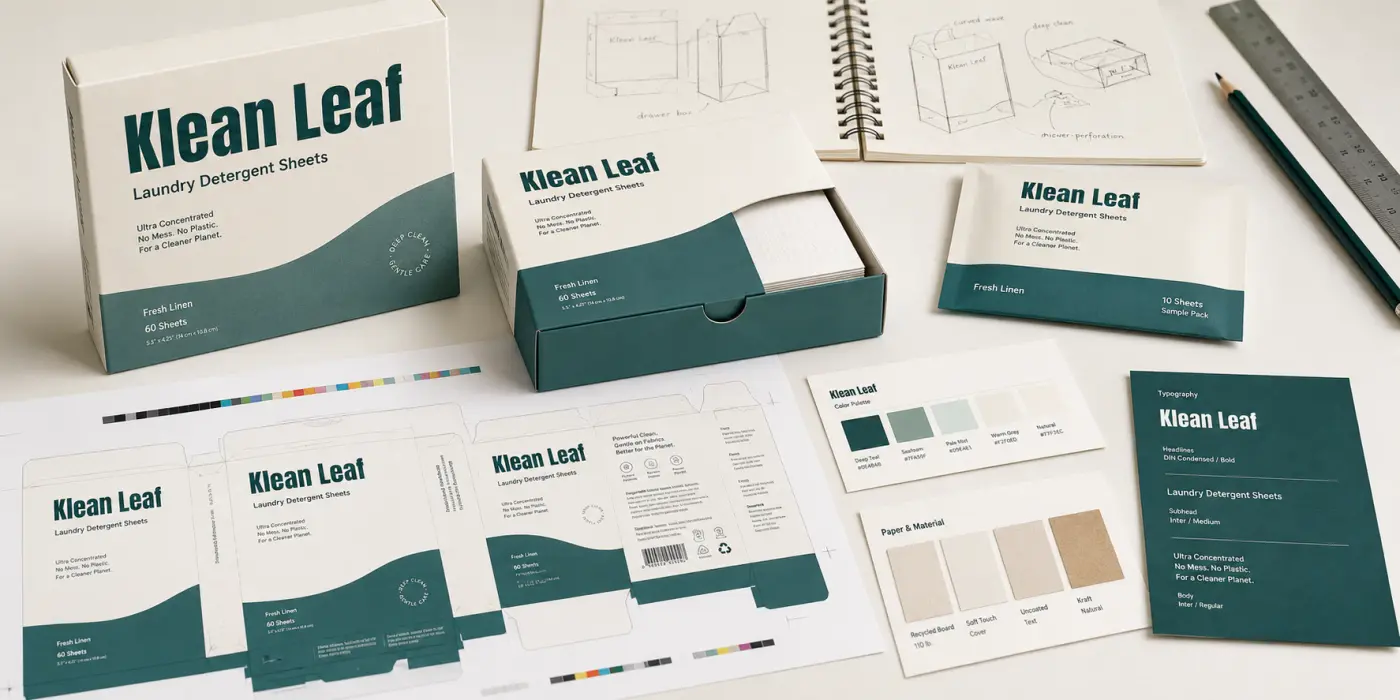
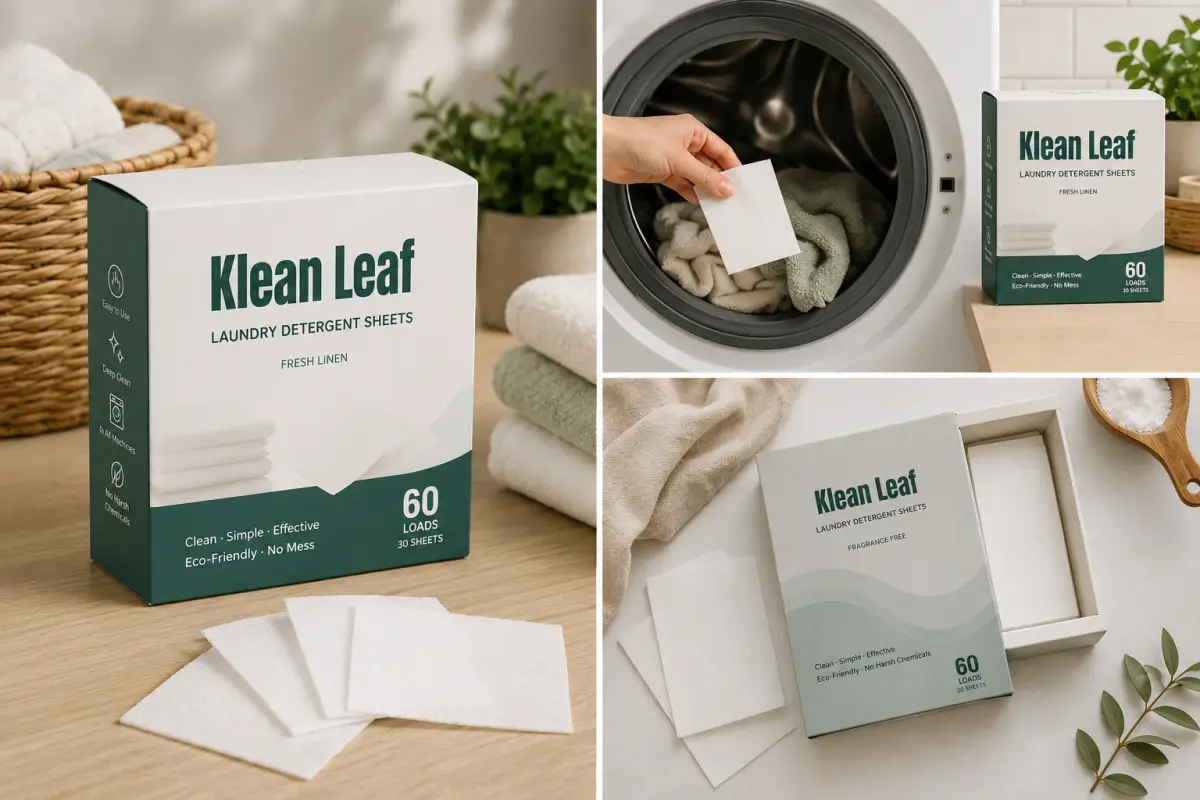
Before your laundry detergent sheets packaging can be approved for printing, the artwork should include the essential product, safety, company, barcode, and traceability information. This packaging compliance guide explains the information Klean Leaf normally asks clients to include when preparing their private-label packaging files.
Please note that packaging requirements can vary depending on your product formula, sales channel, and target market. Brand owners should confirm any market-specific legal or retailer requirements before approving final artwork.
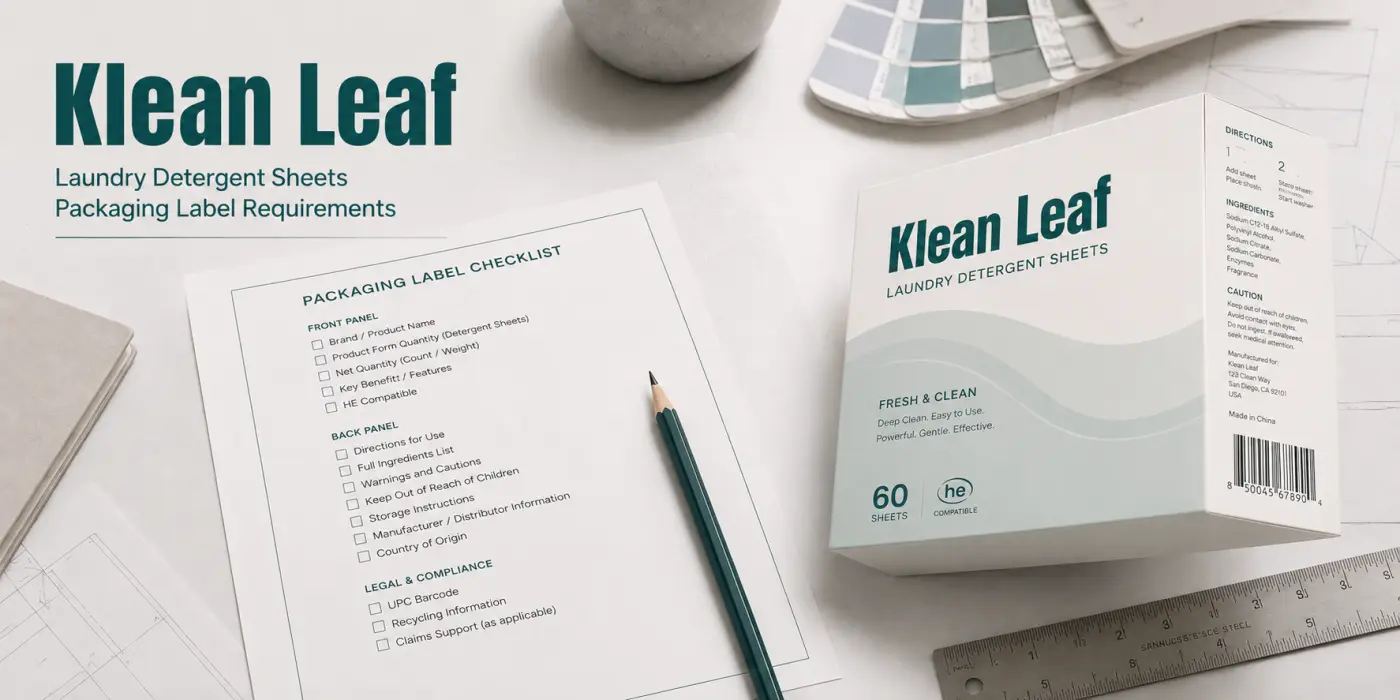
Laundry Detergent Sheets Packaging Checklist
1. Product Name
Clearly display the product name on the package.
The name should help customers quickly understand what the product is. Depending on your branding, this may include wording such as:
- Laundry Detergent Sheets
- Concentrated Laundry Detergent Sheets
- Fragrance-Free Laundry Detergent Sheets
- Fresh Linen Laundry Detergent Sheets
Make sure the product name is easy to read and is not hidden by decorative design elements.
2. Ingredient List
Include a designated section titled "Ingredients" or "Ingredient List."
The exact ingredient list will be sent to you by Klean Leaf based on your confirmed formula. Different formulas, fragrance options, and customized product features may require different ingredient information.
Do not finalize or print the ingredient section until you have received the formula-specific ingredient list from our team.
3. Caution and Safety Statement
Include an appropriate caution or safety statement on the package.
A commonly used statement for laundry detergent sheets is:
Keep out of reach of children and pets. Avoid contact with eyes. If in eyes: rinse cautiously with water for several minutes. If irritation persists, seek medical advice.
The final wording may need to be reviewed based on the formula and the market in which the product will be sold.
4. Barcode: UPC or EAN
Retail packaging normally needs a scannable product barcode.
Products sold in the United States commonly use a UPC-A barcode. Products intended for other markets may use an EAN or another GS1 identification format.
The brand owner is normally responsible for registering and owning the product's barcode. Klean Leaf can place the supplied barcode into the packaging artwork, but the barcode should be registered under the correct brand or legal company.
Complete your UPC registration before final packaging approval so the correct number and barcode image can be added to the print-ready file.
How to Register a UPC Through GS1 US
GS1 US is the official source for GS1-issued product identification numbers in the United States.
At the time of writing, an individual GS1 US GTIN costs a one-time fee of $30, with no annual renewal fee. The GTIN is the unique product number encoded into the UPC barcode.
Official website:
https://www.gs1us.org/
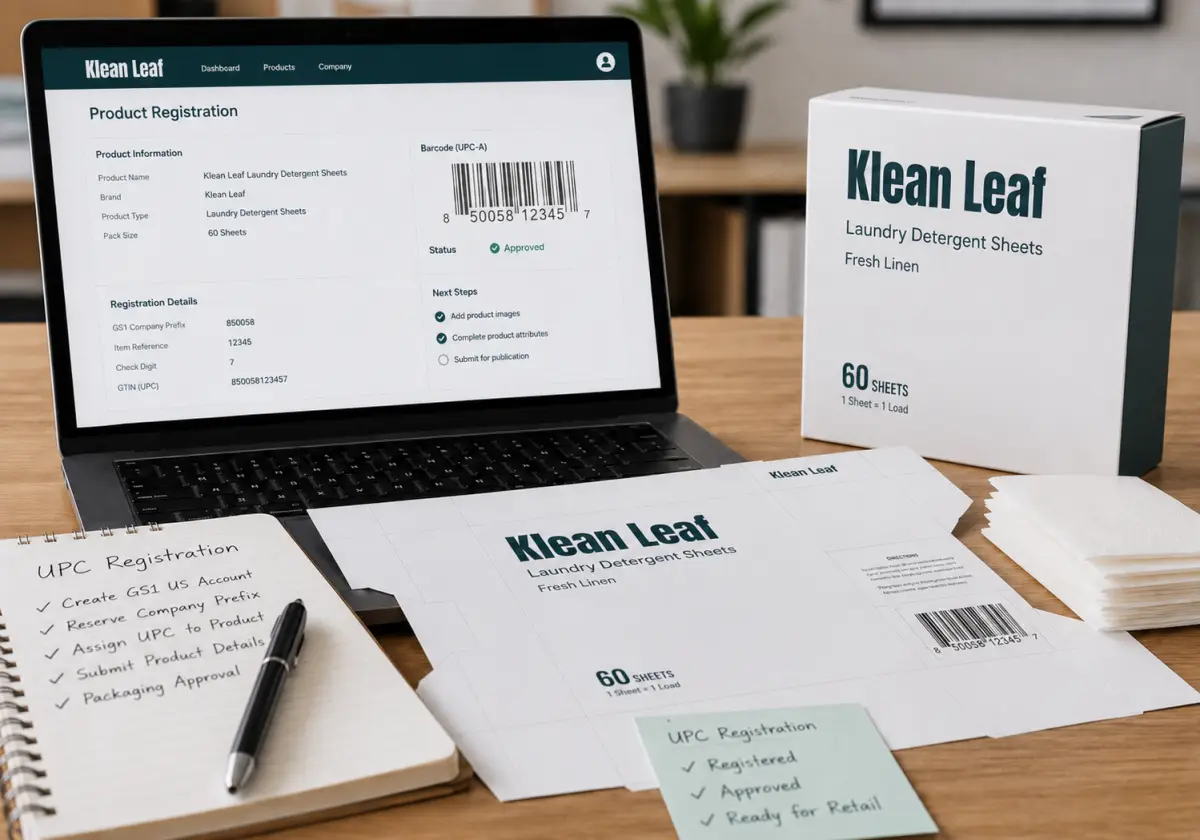
Basic Registration Steps
- Visit the GS1 US website.
- Select the option to obtain a single UPC barcode or individual GS1 US GTIN.
- Create an account using your legal company information.
- Enter the requested brand and product details.
- Pay the one-time $30 registration fee for the individual GTIN.
- Log in to GS1 US Data Hub.
- Add your product information and assign the GTIN.
- Carefully review the product information before setting the product status to "In Use."
- Generate and download the UPC-A barcode image.
- Send both the GTIN number and the downloaded barcode file to the Klean Leaf team for placement in your packaging artwork.
Once a GTIN has been assigned to a product and placed into use, it should not be reused for a different product.
Does Every Product Need a Different UPC?
Each unique sellable product variation generally requires its own GTIN and UPC.
For example, these products should normally have separate GTINs:
- Fresh Linen, 40 Loads
- Fragrance-Free, 40 Loads
- Fresh Linen, 100 Loads
- Fragrance-Free, 100 Loads
A difference in scent, sheet count, package size, or another product-defining attribute may create a separate retail product that needs its own code.
Therefore, a brand with four unique product variations may need four individual GTINs at $30 each.
Brands planning a larger product line should also compare individual GTIN pricing with the GS1 Company Prefix option. A Company Prefix can support multiple product identifiers but has a different initial fee and renewal structure.
Official GS1 US UPC guidance:
https://www.gs1us.org/upcs-barcodes-prefixes/how-to-get-a-upc-barcode
Barcode File Tips
Please send the original barcode file downloaded from GS1 US whenever possible.
Avoid:
- Recreating the barcode manually
- Taking a screenshot of the barcode
- Stretching or compressing the barcode
- Cropping the blank space around the barcode
- Placing the barcode over a busy pattern
- Using a low-resolution image
Our packaging team will review the barcode placement and dimensions as part of the artwork review, but the brand owner remains responsible for confirming that the GTIN and product information are correct.
5. Product Count, Sheet Size, and Net Weight
The package should clearly identify how much product it contains.
Depending on the product configuration, this section may include:
- Number of full sheets
- Number of loads
- Sheet dimensions
- Net weight
- Number of packages included
The sheet count and advertised load count should match the actual product configuration and usage directions.
For perforated laundry sheets, clearly explain whether one full sheet represents one load or whether each sheet can be divided into multiple loads.
6. Company Information
Include the responsible company's legal information on the package.
This normally includes:
- Legal company name
- Registered or business address
- City
- State
- ZIP code
- Customer service email or website, when applicable
Use the correct legal entity rather than only using a brand nickname. Review the company name and address carefully before approving the final file.
7. Country of Origin
Laundry detergent sheets manufactured at our manufacturing campus in China should display:
Made in China
The statement should be visible and legible on the finished retail package.
Country-of-origin requirements can vary depending on the destination country, retailer, and import process. The importer or brand owner should confirm any additional requirements that apply to the intended market.
8. Lot Number and Date Coding
Some brands include a lot number, production date, or expiration date for inventory management and product traceability.
These are dynamic elements and are normally added during or after packaging production rather than permanently printed as part of the static artwork.
Once your order is finalized, Klean Leaf can discuss:
- Preferred date format
- Lot-number format
- Printing method
- Coding location
- Available printing area
Leave a clear and practical area on the package for this information when preparing the artwork.
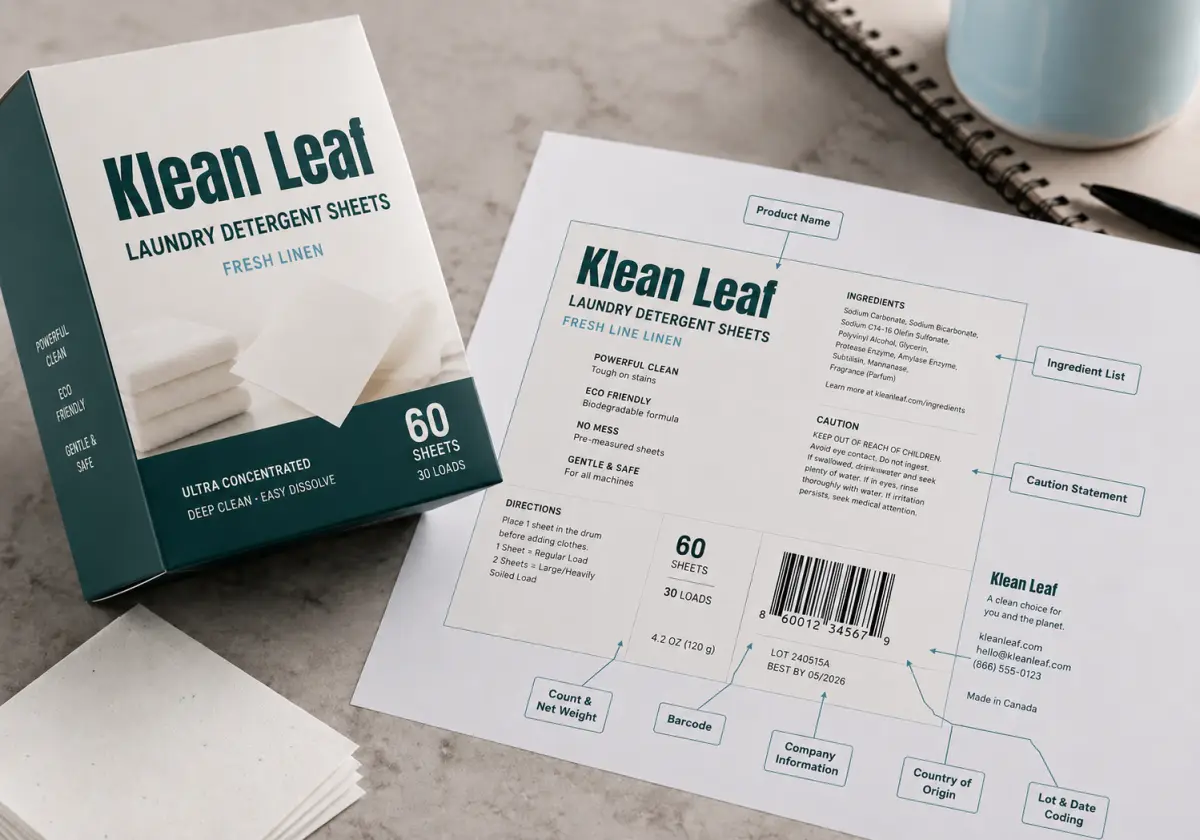
Our team will review the packaging file before production and identify obvious issues, missing information, or artwork areas that may need adjustment.
Preparing for Production with Klean Leaf
Packaging development is a collaborative process. Once the formula, fragrance, product count, packaging structure, and artwork are confirmed, our team will coordinate the next steps with manufacturing and packaging production.
The exact ingredient list will be provided based on your selected formula. Dynamic information, such as lot coding and production dates, can be discussed after the order details are finalized.
Planning these elements early can reduce artwork revisions and help move the project into production more efficiently.
Start Your Private-Label Laundry Sheets Project
Klean Leaf supports private-label laundry detergent sheet projects from formula selection and sampling through packaging development, production, and shipping.
Contact our team to discuss your product idea or submit your packaging artwork for review.
Email:
hello@kleanleaf.us
Website:
https://www.kleanleaf.us/
Frequently Asked Questions
Where are Klean Leaf laundry detergent sheets manufactured?
Klean Leaf client support is based in Columbus, Ohio, and current laundry detergent sheet manufacturing is handled in China by an experienced factory team.
Why is country-of-origin transparency important for laundry sheets?
Private label buyers need accurate origin information for packaging, retail review, customs, and customer trust before launching a detergent sheet product.
What parts of laundry sheet production require quality control?
Formula mixing, drying, cutting, perforation, scent separation, package appearance, carton labels, and final packing all need quality review.
Can Klean Leaf support custom private label packaging?
Yes. Klean Leaf can support package style selection, dielines, artwork review, package samples, production packing, and carton planning.
Confirm the Product Before Preparing Artwork
Review the laundry sheet format and discuss the final formula, sheet count, and package configuration for your project.